Information Management Professional – (IMP®) III Certification
Information Management Professional – (IMP®) III Certification
Course Prerequisite(s)
- Please note that this course has the following prerequisites which must be completed before it can be accessed
-
 Information Management Professional – (IMP®) II Certification
About Course
Senior Practitioner Certification – Level III
Course Overview
The Information Management Practitioner Level III (IMP III) is the senior practitioner certification of the Institute of Information Management (IIM) Professional Global Network – the highest level of the practitioner pathway and the gateway to IIM Fellowship. It is designed for experienced information management professionals ready to operate at the strategic level: developing enterprise information strategies, leading transformation programmes, advising executive leadership and boards, and shaping the future of information management as a discipline.
Where earlier practitioner levels focus on designing and implementing governance frameworks and specialist competencies, the IMP III focuses on enterprise strategy, transformation leadership, and information valuation. The IMP III practitioner does not just manage information – they shape how their organisation thinks about information as a strategic asset and competitive resource.
This programme addresses the competencies required for the most senior information management roles: Chief Data Officer, Chief Information Officer (IM responsibility), Head of Data Governance, Group Records and Information Manager, and Director of Digital Transformation. It equips candidates to develop multi-year enterprise information strategies using TOGAF and the Balanced Scorecard, govern data at enterprise scale using the DAMA-DMBOK2 advanced operating model, quantify information value, and present risk and investment cases to boards with confidence.
Upon successful completion, candidates are recognised as Information Management Practitioners Level III by the Institute of Information Management (IIM) and are eligible for the SPMIIM (Senior Professional Member) membership grade – the highest grade achievable through the practitioner pathway, and the standard prerequisite for IIM Fellowship (FIIM).
Learning Objectives
By the end of this certification programme, participants will be able to:
- Develop a multi-year enterprise information strategy aligned to corporate strategy using TOGAF data architecture principles and the Balanced Scorecard framework
- Conduct an enterprise information maturity assessment and develop a transformation roadmap
- Present an enterprise information strategy to board and executive audiences in business risk and value terms
- Design and implement an enterprise data governance operating model using the DAMA-DMBOK2 framework across all 11 knowledge areas
- Define and govern Critical Data Elements (CDEs) across complex, multi-system enterprise environments
- Lead enterprise-scale IM transformation programmes over multi-year horizons using advanced change management and programme governance disciplines
- Quantify the value of information assets and the return on investment from IM improvement using recognised information valuation methodologies
- Develop and present cyber risk, privacy risk, and information governance risk reports at board level in financial and strategic terms
- Assess the information management implications of emerging technologies including artificial intelligence, blockchain, cloud computing, and the Internet of Things
- Design an IM technology strategy aligned to the enterprise digital strategy
- Build, lead, and develop high-performing senior information management teams
- Prepare a Fellowship application demonstrating distinguished professional contribution to the information management profession
Course Content
Module 1: Enterprise Information Strategy
Module 2: Advanced Data Governance and Stewardship
Module 3: Leading Information Management Transformation
Module 4: Emerging Technologies and the Future of Information Management
Module 5: Information Valuation and Business Case Development
Module 6: The IIM Fellowship Track and Senior Professional Leadership
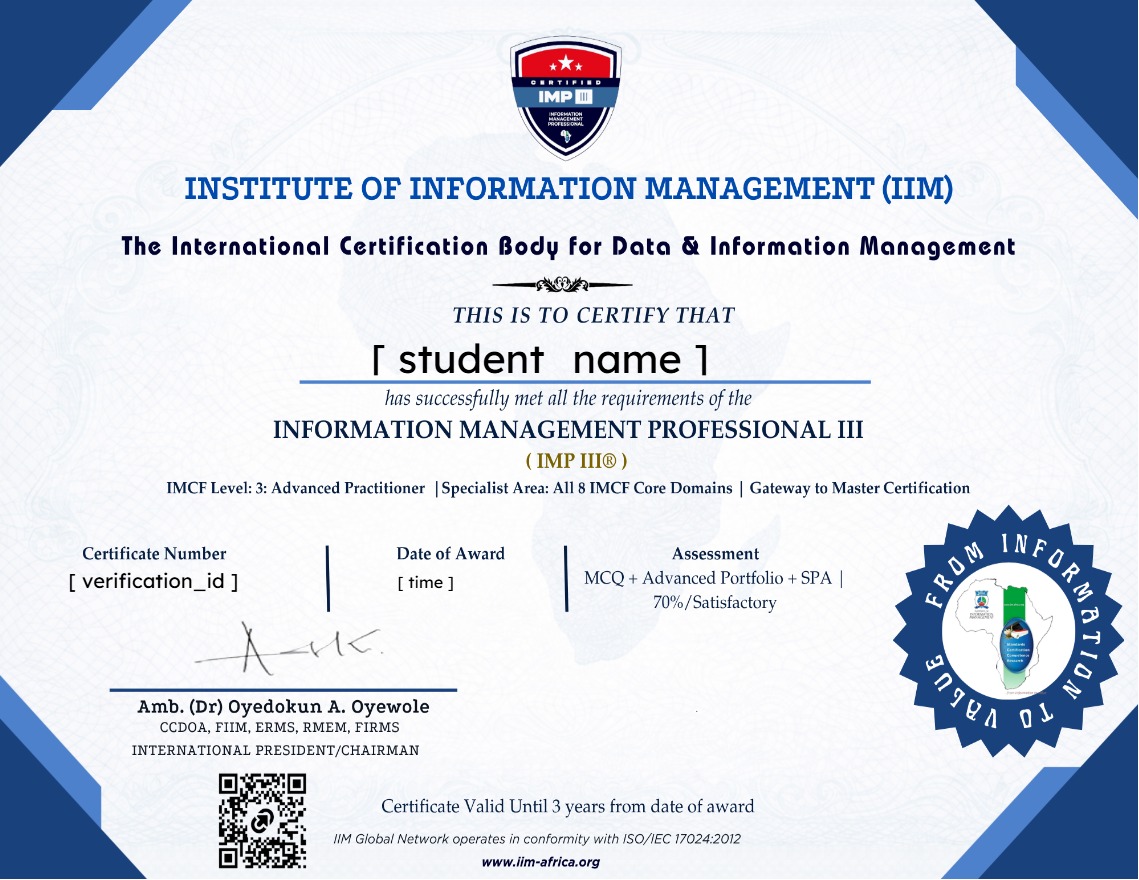
Earn a certificate
Add this certificate to your resume to showcase your skills and enhance your visibility in the job market.
Student Ratings & Reviews